How Can Gardens Inspire Creativity?

A Book Full of Garden Dreams

I’ve been immersed in a hefty coffee table book from the library called The Writer’s Garden: how gardens inspired the world’s great authors. As the title suggests, these literary giants found creative fuel in their personal gardens—sanctuaries of beauty, and solitude.

Many of them dreamed of a self-sustaining life, planting sprawling vegetable gardens, fruit trees, and berry bushes alongside beautiful flower beds. Some chose the lifestyle to stretch a modest income and make room for writing. Others used their royalties to create the dream environment they had long imagined. But all of them shared one thing: a deep need for the beauty of a garden. It wasn’t just a backdrop—it was fuel. The natural world grounded them, offered rhythm and renewal, and gave them the energy to focus deeply on their craft.
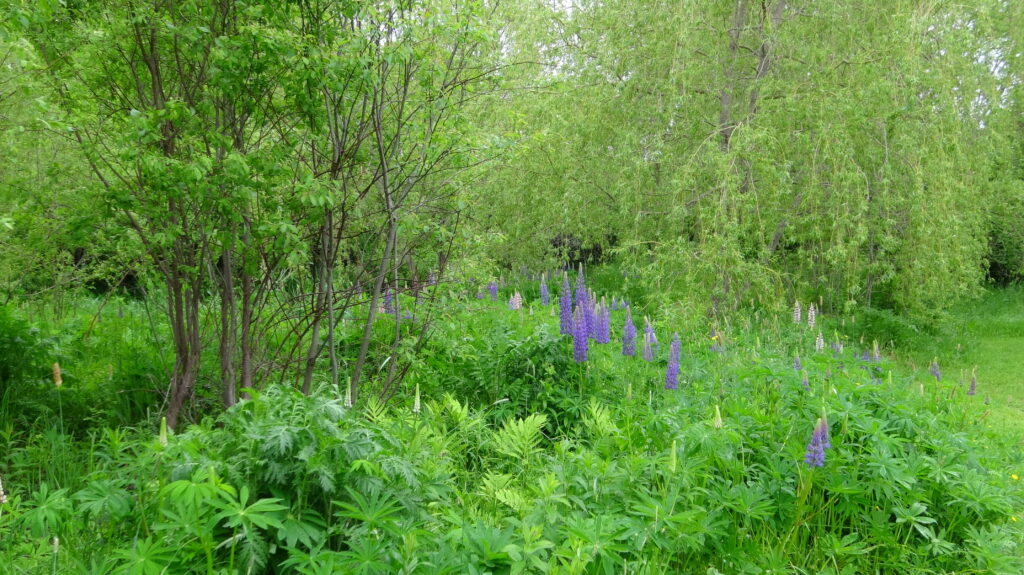
Their garden visions echoed my own when Larry and I left our narrow semi-detached home in downtown Toronto in 2007, heading toward a rural life in Bear River. Like those writers, I longed for a quieter life, rooted in nature—one where creativity could grow alongside the tomatoes and flowers.

Our First Garden Oasis

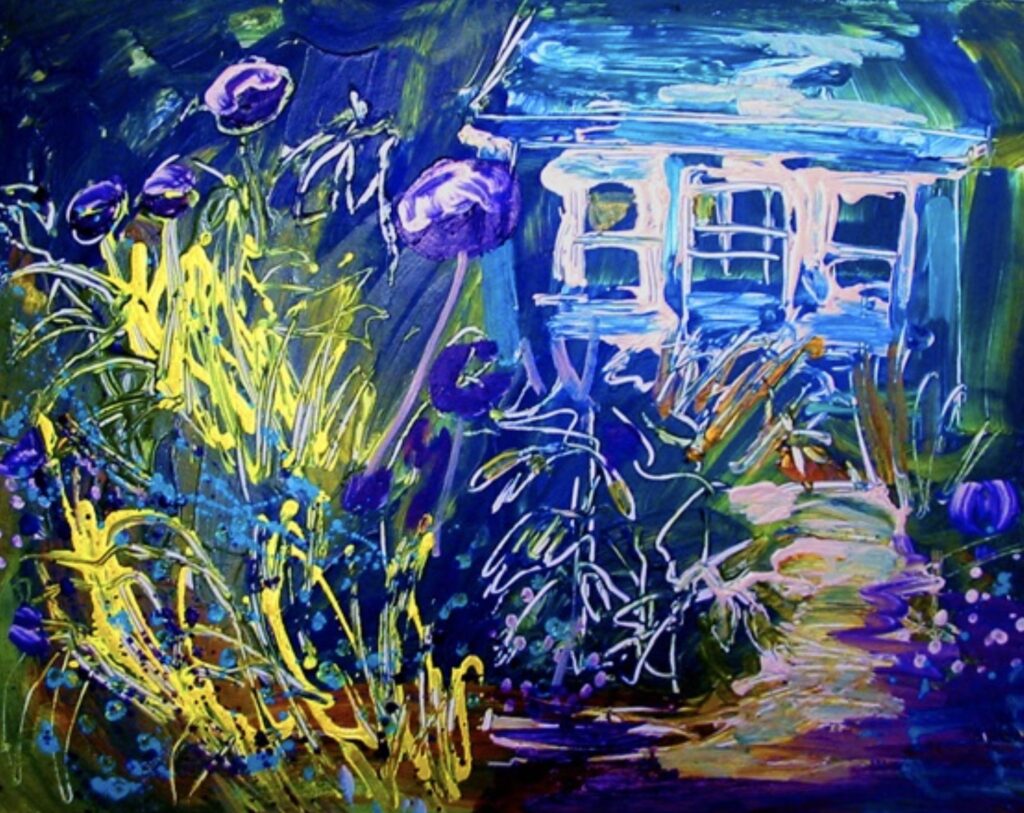
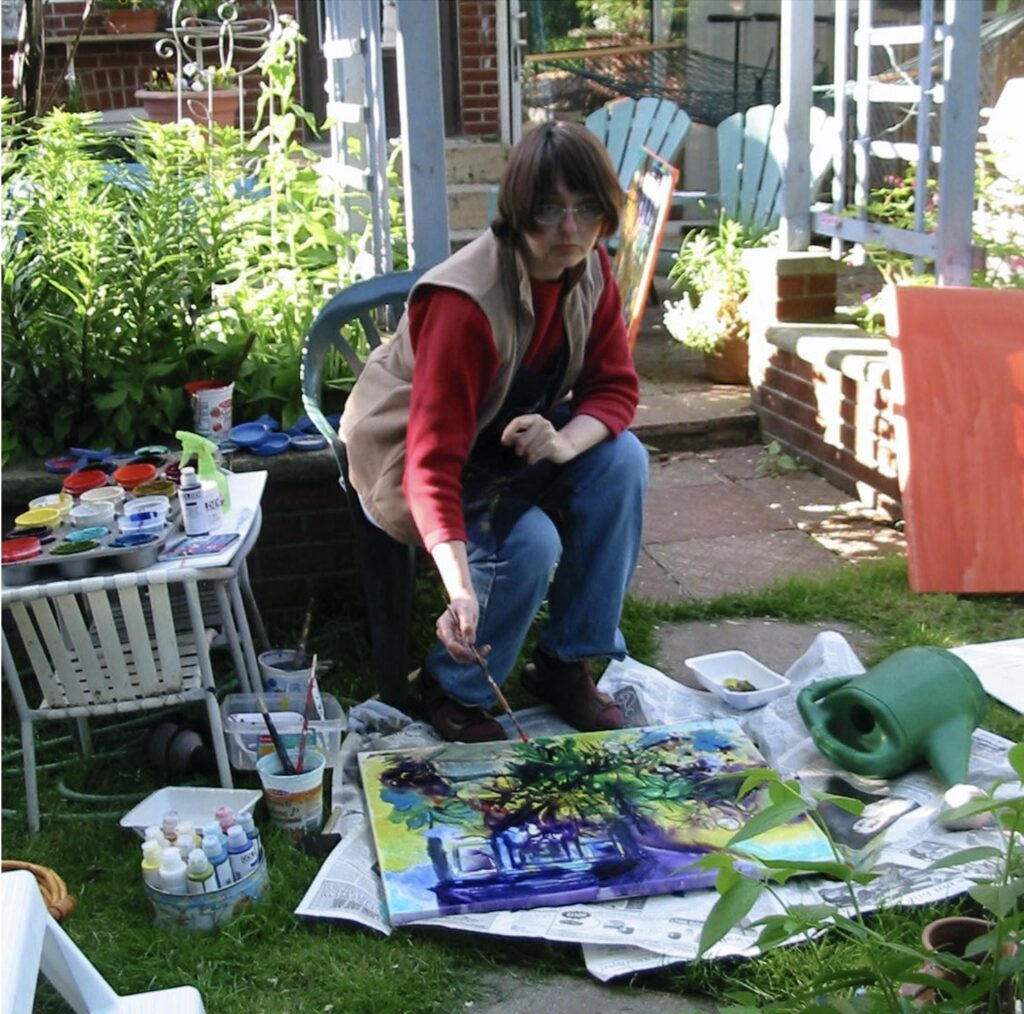
Back then our Toronto garden was small, about the size of a modest room, tucked in the backyard and ringed with tall, gangly trees that cast shifting shadows on everything below—especially on the few brave vegetables I attempted to grow. Still, it was our precious little oasis. Private, lush, and alive. In the warm months, it became an outdoor room where we ate most of our evening meals. I painted out there too.
The Reality of Garden Work

But back to the book. What struck me most was that like us, some of these writers hadn’t anticipated the work involved in homestead farming—or even maintaining a small home garden. Some said that gardening pulled them away from their writing.

Reading that made me smile and feel so much better about my own efforts. I often feel that same tug-of-war between my garden, my studio, and daily life with the endless rhythm of meal prep. And yet, I enjoy my garden time as much as painting. Theoretically, I now have the time to develop my ideas for painting, writing, and gardening—but I don’t have the same stamina I had at 47. I confess that at 74, I still haven’t quite mastered how to schedule my time effectively.

Still Creating, Still Growing

But I keep trying. I enjoy everything I work on whether it’s with a brush or a shovel, and that’s a very good thing.

But it feels even better to read that I’m in good company. Many creatives—past and present—have wrestled with the same balancing act. It’s oddly comforting to know that the struggle to manage time and energy and tasks is part of the human condition.

——————————

A Helpful Habit

One thing that has truly helped me maintain my strength and stamina for this life is attending yoga two mornings a week here in Bear River. But more on that in another post.


Reviving Creativity: My Journey Back to Painting

I don’t want to jinx it, but I’m thrilled with the paintings I’ve been working on these past few weeks.

Thrilled—because all winter, my desire to paint had vanished. I stopped seeing the world through a painter’s eyes. Artists, photographers, creators are observers, endlessly noticing color, shapes, shadows, and hidden vignettes in the ordinary. I love seeing the world that way.

But last winter, that lens went dark. Scenes that once begged to be painted left me numb. It was unsettling, like losing a sense. On top of that, shingles and COVID drained my energy, locking me further away from my easel.

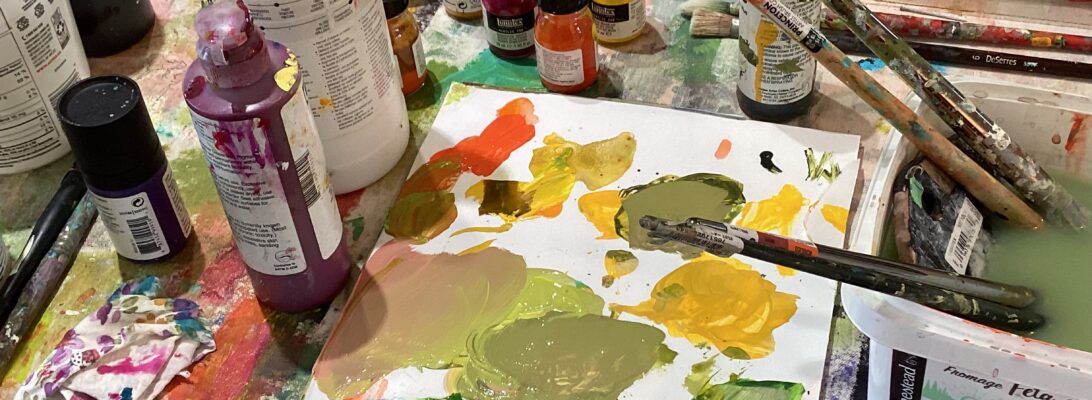
Yet creativity is stubborn. It lingers in the subconscious, waiting. Like muscle memory, it can flicker back to life with patience and practice. And now, here I am: grateful for time to nurture my garden into a living palette, to lose myself in brushstrokes again.

My only other commitment? Muddy Duck Yoga twice a week—a wonderful ritual that fuels both my body and my art.

After months of drought, I’m finding my rhythm again. And it feels fantastic.

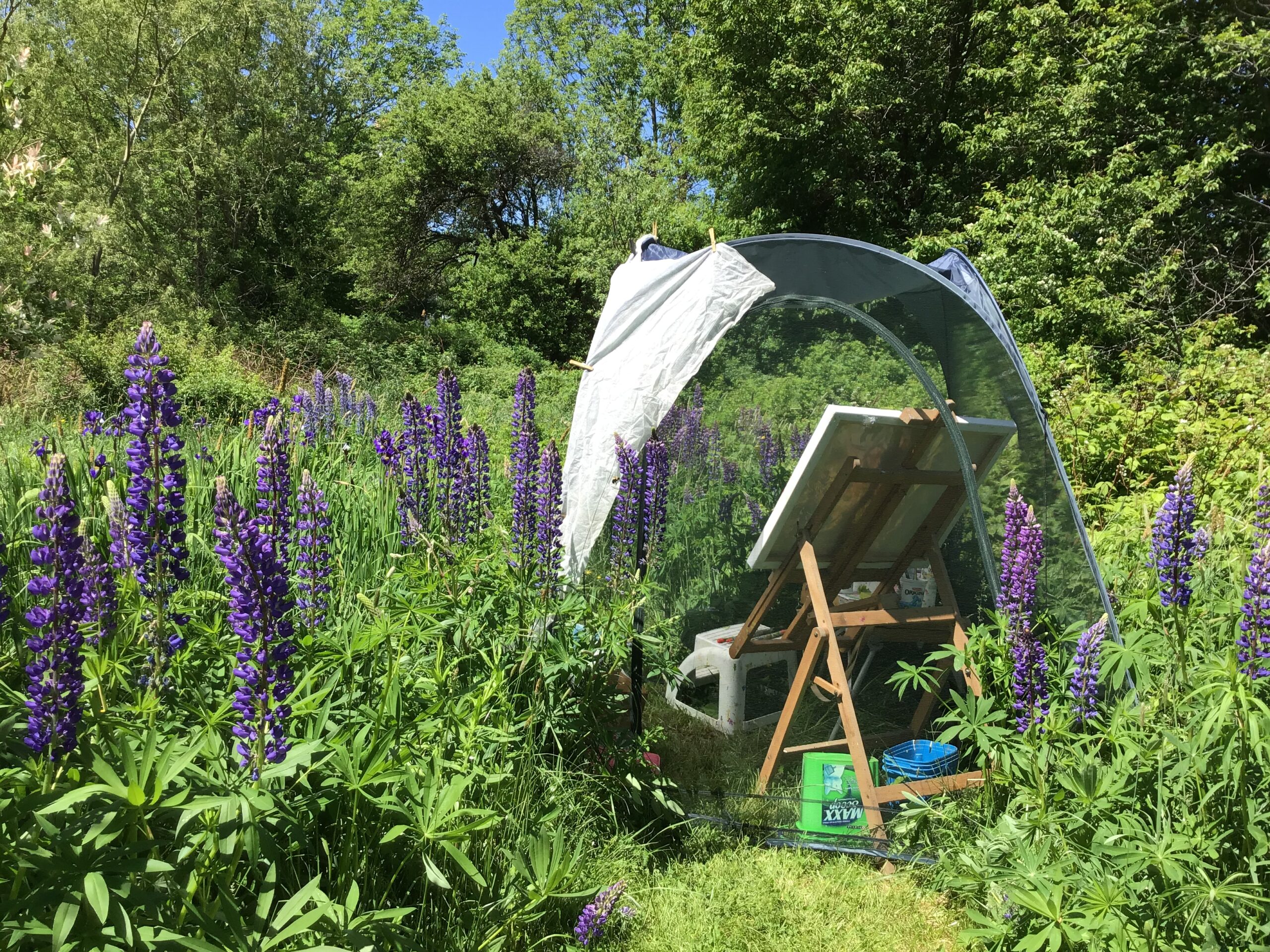
It started with surrender. Letting go of expectations and feeing lupin joy again.

The Gift of Change

It’s been about a year since I last posted, and over that time, three significant shifts have reshaped my creative life.

Last fall, after ten fulfilling years in a co-op gallery I helped to found in Bear River, we made the difficult decision to close its doors. Letting go of Bear River Artworks Gallery was bittersweet — a goodbye to a community space, shared energy, and the experience of seeing my work alongside others’. But it also opened up personal room for quiet, for personal expansion, and for a different kind of creative exploration.

Then came winter, and with it, an unexpected stretch of illness — first shingles, then Covid. Both forced me to slow down, to listen more closely to my body, and to let go of any expectations, schedules or illusions of control. I watched the shifting winter light across my bedroom wall, and slowly an idea unfurled. I needed to realign my creativity, to expand it. I needed to rethink my studio activities and space.

I spent weeks in my head, rearranging my studio. What began as a practical response to shifting circumstances became something more meaningful — a quiet recognition that I am not the same artist I was a year ago. Part of my recovery was to sit in the studio and visualize a new layout and organization. The space I’ve created now feels like a reflection of that: a place to write, to experiment, and to allow the next phase of my work to emerge. I’ll tell you more about this in my next post.

I share this here because I know many of you, too, are living through seasons of change — creative, personal, or otherwise. I’m reminded that creativity doesn’t just live in the big, finished pieces we show the world, but also in the quiet ways we adapt, heal, and prepare the ground for what’s next.

Thank you for being here, reading along. I’d love to hear how this past year has shaped your own creative life. What have you had to let go of? What have you rearranged — inside or out — to make space for what’s coming next?

The Healing Properties of Daffodils, Turtles and Goutweed

Something fairly profound happened for me this month.

I have felt quite sluggish this winter. Not actually depressed but just completely unmotivated, disinterested, lazy and believing that my strong desire to paint had completely abandoned me. This was quite distressing because there was absolutely no substitute interesting endeavour that came to mind. Nothing. Not writing. Not gardening. Not visiting. Not travelling. I wondered if this is how the end begins.

Continue reading

How I Learned to Promote my Artwork while Living in the Middle of Nowhere*

“Left a good Job in the City. Workin’ for the Man Every Night and Day…” Proud Mary, John Fogarty 

Thirteen years ago,  my husband and I ditched our jobs in the big city and moved to this sparsely populated province. Our dreams were all about creativity and community.  I yearned for the luxury of having time to paint.  I yearned for nature. And I hoped I would be able to find a market for my artwork. Continue reading

After the Abstract Painting Workshop – taking action

The process of learning to make art  is like that of learning to speak. You learn the language, the grammar, the idioms. But what you say with it is totally up to you.
– Jane Davies in Abstract Painting: the elements of visual language.

I am inspired by a recent painting workshop with abstract painter Leya Evelyn, and I want to tell you about it with this video to give you a peek at my new painting series. Continue reading

Creativity is Part of our Humanity

 I’ve been reading and thinking about ‘creativity’ and where it comes from. Years ago I purchased Julia Cameron’s book, The Artist’s Way, about accessing your inner creativity. I didn’t get around to reading it until we moved here to Bear River 9 years ago. I was so busy working in a library office that my limited ‘free’ time was spent painting, not reading about it. The book was a reminder of my frustration about my lack of creating time.  I never imagined that I would be living in a gorgeous little village with years ahead of me to make art. Continue reading

The Ripple Effect of Showing Your Art

You know how it is. Sometimes you plan one thing and it leads to another which leads to still another.

Just for you.  painting by Flora Doehler
Just for you.
16″ x 16″
acrylic on canvas
painting by Flora Doehler (sold)

The action of putting together a show of my paintings earlier this year in the dead of February and the doing led to:

  • finishing quite a few in-progress paintings and wiring up all completed paintings
  • inventorying /digitizing/ naming and pricing of all the large paintings I have for sale which will make it so much easier to shop my work around to other venues
  • creating a digital Art Newsletter for people who have purchased my work, who might like to view my work and for local media and galleries who I would like to approach for future represention. This led to the development of a comprehensive email list
  • giving a series of watercolor classes at our studio which led to the development of a new curriculum for experimental watermedia and a wait list for more classes as well as some income
  • giving an artist talk /slideshow /presentation of my work to a group of live people which led to my unearthing and digitizing important art works from my early years which led to some  self-reflection on my developement as an artist
  • Finally, even though people have seen my work at various venues including in our studio, it didn’t prepare them for seeing a collection of 30 paintings in one place. That was a real eye-opener for me about the importance of viewers being able to see a lot of your work at one time to get a true sense of the type of painting you do.

painting by Flora Doehler
The New Arrivals
18″ x 24″
mixed media on canvas
painting by Flora Doehler
$725

For these reasons alone, the art show would have been a great success for me. But that’s not all. I had the chance to talk to people about what I do and why I do it. Most artists work in solitude and in spite of posting images via the internet, there is nothing like seeing the work live and having a real conversation with viewers and collectors for an exchange of ideas and reaction to take place. I also sold paintings which was a wonderful affirmation and motivation to continue.

If you are sitting on a collection of your work, whatever it may be, I suggest you take the step of arranging your own pop-up show because it will lead to new opportunities for your growth as a person and as an artist.

work table


Intentions for 2011 at Green Willow Studio

Our Green Willow tree,  Cordelia, has finally dropped her leaves. A Cherry tree stands to the right and produces tasty cherries that drip down your chin in the summertime.  Mostly the birds get the bounty as the limbs are too high for us to reach. Our studio is the red building. The other two ‘public sides’ are painted periwinkle blue. We heat it with a wood stove and a small space heater.

2010 was the ‘birthing’ year for our Green Willow Studio. We started with an uninsulated garage and transformed it into a warm, walled and electrified studio! It took us some time to get everything arranged so that a silversmith and a painter could work in the same space. Together, yet apart.

Most of the time it works. We listen to music or to podcasts. We break for tea or coffee and either talk about our work or we go for a walk around the garden to get a different perspective.
It is a thrill for us both to have the luxury of such a well lit room (there are windows on all four walls!) and to be surrounded by garden and a wild field where pheasants live.

As part of the Bear River working artists studio tour it was essential for us to have our studio ready for the beginning of the tourist season in May. We set up a display area in the studio where people can buy our work.  We have met some wonderful people that way and have sold some pieces.

Tulips. Acrylic on canvas by Flora Doehler. SOLD


My painting sales this year at the Flight of Fancy, at Paint the Town and in the studio were motivating and rewarding.  A series of one-on-one art coaching and tutoring in painting has helped me to share my painting techniques and to practice teaching. Attending the Bear River Artists and Farmers Market nudged me to develop affordable art as well as gave people a chance to see my work.


Larry received jewellery commissions and is showing sculptural pieces at Art and Jules Gallery in Halifax.


“Growth Spurt” hammered copper vessel by Larry Knox, 2010.
Now 2011 lies before us like a blank canvas or like a shiny sheet of copper waiting to be formed.
The possibilities are infinite; the ideas are many and there are decisions to be made about content, about intention, about the best way to express one’s creativity.
Blooming summer flowers were a constant inspiration.
 I will spend more time posting to this blog and sharing step-by-step, the creative discoveries and techniques that I am using in my work and that Larry is using in his work. Up until now my blogging focus has been on our day to day lives in our adopted village of Bear River. After three years there are over 100,000 hits on that Blog and it has even brought visitors to Bear River. It’s time for me to shift some of the energy spent in promoting Bear River into sharing our artistic life and promoting our work to the world!
Commissioned copper and silver bracelet by Larry Knox.
Copper pieces.


Larry and I are excited about these developments and we look forward to sharing our creative journey with you in this coming year.  Thanks for your virtual visit!
Happy New Year and may you experience many creative moments in 2011 and may some of them be inspired by our creative journey.
Painting outside in the summer.

Fibre Arts Course — online from South Carolina

While my main form of artistic expression is painting, working with textiles has a big appeal for me too.

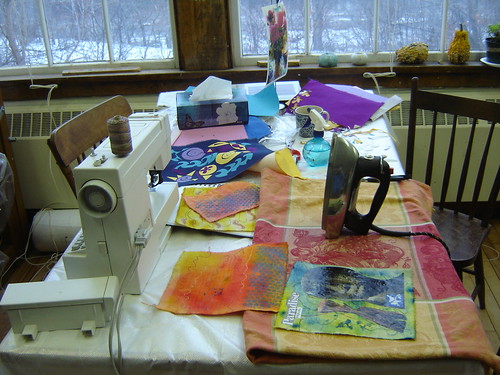
Playing with fibres in the studio.
Playing with fabric and fibres in the studio.

At different times in my life I have woven, screen printed on fabric and sewed with appliqué.

Cotton warp.
Hand woven cotton warp.

My approach to textile work is very similar to painting. In both cases I use strong colour; I enjoy lots of texture and I use the interplay of light and dark and complementary colors.

Fabric painted with acrylic, printed with bubble wrap.

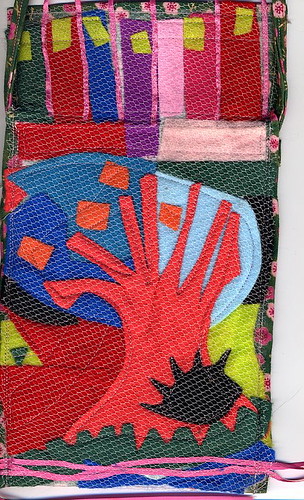
Many, many well-known painters have worked in this medium. Last spring in Los Angeles I saw some beautiful paper appliqués by Matisse in the museum there that inspired me to sew this little bag.

Cotton, arctic fleece, netting and ribbon.

My daughter Emily is an animator and I am inspired by how she integrates her animation sensibilities into her sewing.

Emilys handmade doll.
Emily designs, sews and paints dolls and creatures.

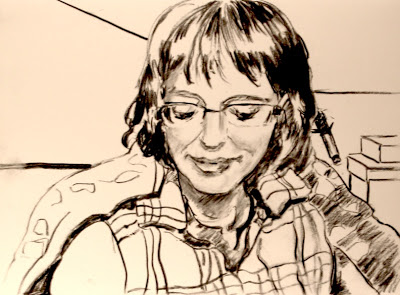
Another source of inspiration for me is artist’s blogs and sites on the Internet. I check the daily blog of my friend and fellow painter Barbara Muir. I love her use of colour and we had many shows together in Toronto. Her persistence at writing a daily blog about painting inspires me to create and make better use of all the precious time I have.

Barbara drew me while we talked on Skype!

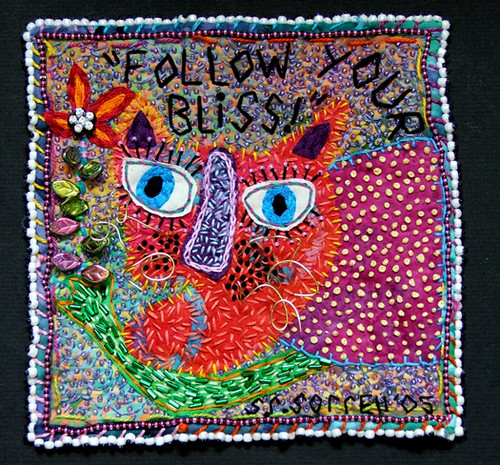
Recently I came across the site of Susan Sorrell, a fiber artist. Her work excites me because of her bold use of color and texture. I signed up for an online class with her called Personal Symbols — who could resist signing up for a course with the name like that!

Susan Sorrells work
Susan Sorrell’s work.

Susan has been teaching for a number of years and the course comes with PDF handouts with lots of photographs. She has a forum on the Internet for the class where participants can show and tell their progress. I haven’t used the exact materials on her list. I’m adapting what I already have. Susan suggests painting fabric dye on interfacing fiber, but I’m using canvas and watered-down acrylics.

The assignments use a combination of drawing, painting and sewing which is quite exciting for me to combine.

Combining symbols
Combining symbols.

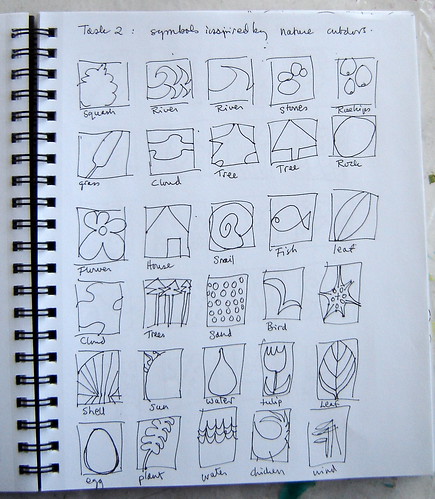
There are at least three assignments connected to each of the six lessos. Ingeniously she had each of us draw and make up some of our own symbols.

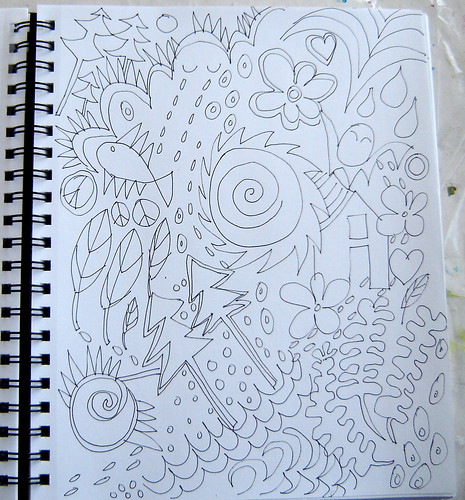
My symbols
My Symbols.

In the following image I have cut out and combined some of my symbols. The fabric is cotton and I ironed a stitch witchery product to the back of the cloth before I cut the pieces out. In this way the pieces stuck down when ironed. Then I embellished it with buttons and beads.

I would like to try some of these techniques in acrylic on a large canvas. It’s nice to know that it’s possible to take a course online and to feel so inspired by it and by the links to images and blogs and websites of other participants.

[youtube=http://www.youtube.com/watch?v=DXjgxxdJPtE;rel=0&w=425&h=350]

Susan Sorrell offers quite a few different online courses. Her enthusiasm comes across loud and clear and I would recommend any of her courses. She also hosts a monthly chat with people in the creative arts and that is quite inspiring too.

The course is opening a new world for me…a truly virtual community of people combining paint and fabric and a passion for creativity.